Study Goals and Objectives

Research is prompted by need to get feedback on multiple new shopping concepts intended for the Client Product response under the shopping tab. Study aims to provide directional insights to prioritize new Client Product concepts by gathering user feedback on their perceived value and usability. Findings will inform cross-functional workshops to determine which concepts should be developed into engineering demos for future Client Product launches.
  • Objectives: 
  • Understand how the context in which Client Product is used (on social media or retailer/brand website) affects the user’s perception of and expectations for Client Product. 
  • Explore how ppts understand specific use case modules and learn which are perceived as helpful and why 
  • Identify how the value of modules might change depending on various shopping intents (shopping vs identification)
  • Assess users expectations for and reaction to results and response about specific shopping products, as they move between concepts within Client Product

Research Methodology

  • Protocol:
  • 60 minute 1:1 interviews via Discuss.io
  • Tested 3 flows of the prototype, counterbalanced
  • During the session, ppts walked through low fidelity concepts via a prototype on their mobile device
  • Notes/Caveats:
  • Small sample size 
  • Testing conducted with early artifacts 
  • Testing event will not 100% reflect real-world behavior 
  • Tested concepts demonstrate ideal experience when an exact product match is shown. 
  • Participants:
  • 8 participants (US Residents)
  • Mix of Client Product usage frequency 
  • Mix of familiarity with AI Tools
  • Browse/ shop online

Product Overview

  • Client Product* is  sub-product of already existing overall product.
  • Client Product is a tool that lets users search and shop using visual cues instead of only text.
  • Connects what users see to relevant product information, comparisons, and purchase options.
  • Surfaces related or similar items to help users discover alternatives.
  • Purpose is to bridge the gap between inspiration and action in online shopping.
  • Attempts to integrate seamlessly into existing search/shopping flows.
  • *Will refer to as Client Product due to privacy reasons

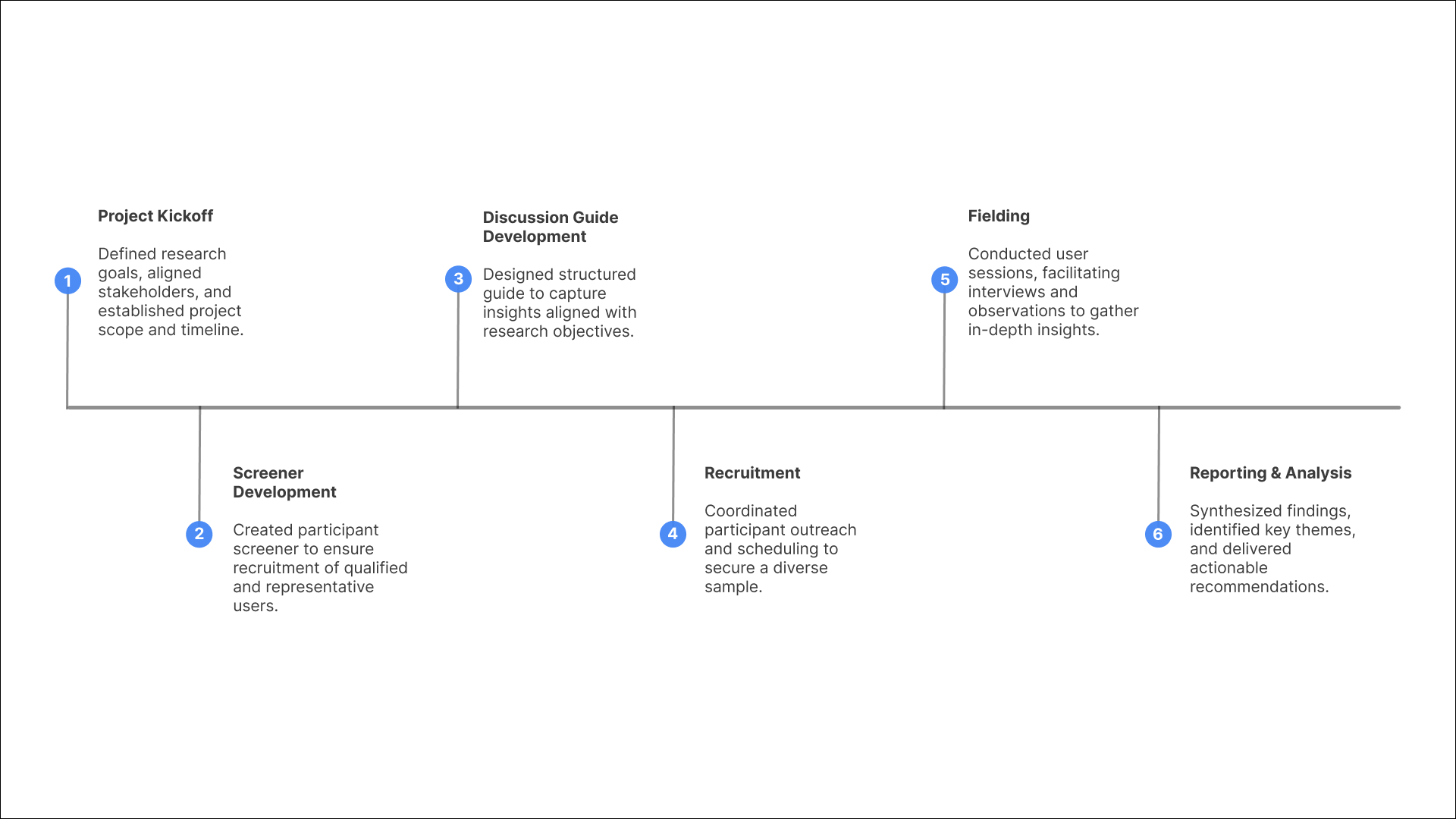
Project Timeline

Prototype Flow 1

  • Screen 1: Sunscreen in the Context  of Social Media
  • Screen 2: AI Description of Sunscreen
  • Screen 3: Shopping Page for Sunscreen
  • Screen 4: Ask a Question Prompt
  • Screen 5: Ask a Question Response

Prototype Flow 2

  • Screen 1: Bag in the Context  of Social Media
  • Screen 2: AI Description of Bag
  • Screen 3: Shopping Page for Bag
  • Screen 4: Bag Use Case Modules
  • Screen 5: Bag Use Case Modules

Prototype Flow 3

  • Screen 1: Skirt in the Context  of Social Media
  • Screen 2: Try on Bag Feature
  • Screen 3: Shopping Page for Skirt
  • Screen 4: Skirt Use Case Modules

Insights

  • The integrated overview and main search experience gave participants a clear snapshot of shopping product details, comparisons, and feedback, which naturally guided them toward either direct purchase options or more focused exploration of related items.
  • Across product types and decision stages, participants valued seeing pricing information surfaced early and reinforced throughout the experience, including in comparison views and context-specific modules (e.g., curated sets under a certain price point).
  • Quick product recognition was a strong driver of initial engagement, with the overview helping participants confirm what they were looking at and access general information before diving deeper into details or alternatives through specialized modules.
  • Additional features, such as interactive Q&A or virtual try-on concepts, contributed to the sense of a “one-stop shop” by streamlining the process of gathering information, validating options, and exploring similar products.
  • While participants primarily associated the tool with product recognition, concept explorations such as virtual try-on and AI-assisted Q&A were perceived as innovative and valuable. Participants could envision using them in future scenarios, like coordinating outfits for an event or checking compatibility between products.
  • Participants understood that generated images might not be perfectly accurate given current technology. Common concerns included fit (e.g., body type, height) and product rendering (e.g., lighter colors, fabric appearance). Despite these limitations, the virtual try-on concept was highly valued for its ability to help users visualize how products might work with their existing wardrobe.
  • A shift in terminology from a more generic label to a more action-oriented one was well received. Participants felt the updated naming conveyed clearer intent without causing confusion.
  • Within the shopping experience, specialized modules (e.g., filtering by color, curated sets, or “products to consider”) supported discovery. Participants appreciated the progression from exact matches to broader, more exploratory options.

Recommendations